
Praise for Lead with Civility: Phoenix Arising | Dr. Ron Dart’s Prelude


Lead with Civility: A Handbook for Uncivil Times launched this week to an extraordinary response, debuting as the #1 Amazon bestseller in Government & Politics. This reception confirms what so many leaders are telling us: the hunger for sane, principled, and courageous leadership has never been greater.
In this post, we’re opening the book itself to share something rare—a compelling Prelude by Dr. Ron Dart, one of Canada’s most respected scholars and public intellectuals, and the author of more than 40 books.
In his earlier British Columbia Review of Save Your City: How Toxic Culture Kills Community & What To Do About It, titled Where is Civility Going?, Dr. Dart praised the book’s clear-eyed diagnosis of civic breakdown and its hopeful, practical roadmap for renewing community life, and he urged readers not just to read it, but to “inwardly digest” its insights and let them shape their public engagement.
His new Prelude to Lead with Civility goes a step further, framing this leadership handbook as a phoenix rising from the ashes of toxic culture and inviting leaders into a deeper, more hopeful way of exercising power.
Read on to experience Dr. Dart’s Prelude in full and let it prepare you for the journey that follows in Lead with Civility.
Phoenix Arising | Lead with Civility Prelude
by Dr. Ron Dart
I cannot praise a fugitive and cloistered virtue, unexercised and unbreathed, that never sallies out and sees her adversary, but slinks out of the race. — John Milton, Areopagitica
There are seasons in political life when moderation, thoughtfulness, and elementary respect are front and centre. There are also seasons when conflicts breed contempt, when barking rhetoric and crude polarisation drown out dialogue, when mindless ideologues trash those they differ with. Meaningful citizenship requires a civic mind; when perspectives collide, civility should win the day.
What happens, though, when people retreat into cynicism or enter with ideological guns blazing?
The destination for both is the Cyclops’ cave—a place from Homer’s Odyssey, where a one-eyed giant saw the world only from his narrow vantage. Lacking depth perception, he flattened complexity and mistook strangers for enemies, trapping them in darkness rather than engaging them.
In civic life, this cave is where curiosity dies, empathy is blind, and dialogue is devoured. The challenge before us is to step back into the open, where many perspectives can meet, and where our vision—restored to two eyes—can guide us toward a saner, more just, more dialogical public life.
Diane Kalen-Sukra, to her admirable credit, has mined the gold of the classical approach to public life and taken us on this journey, bringing forward a bounty of wisdom and practical insight.

Her book Save Your City: How Toxic Culture Kills Community & What to Do About It sounded a ram’s-horn wake-up call to those denying the problem, hiding behind gates, or pandering to it. The fact that toxic culture and the culture wars have only quickened since then makes that book a needed manifesto. I might add, one and all with a minimal public conscience should read and inwardly digest this classical beauty.
Since then, Diane has invested deeply in the work of civic renewal—founding an academy for civic leadership, carrying her message across the globe, and working shoulder-to-shoulder with leaders committed to strengthening the fabric of public life.
Lead with Civility: A Handbook for Uncivil Times is, therefore, a phoenix-like rising from the ashes of what must die so that meaningful public community and discourse might be reborn. In the myth, the phoenix’s tears bring healing to those it touches.
Like the mythic phoenix, Diane knows the difficult journey of seeing through the illusions of much social media and intellectual thinness; she has listened across the ideological spectrum, worked with those able to transcend tribalism, and borne disappointments without losing heart.
This book threads together, wisely and well, many of her time-tested insights and practices with laudable reflections from men and women who know its costs and challenges well—certainly no cloistered virtues or slinking from the race.
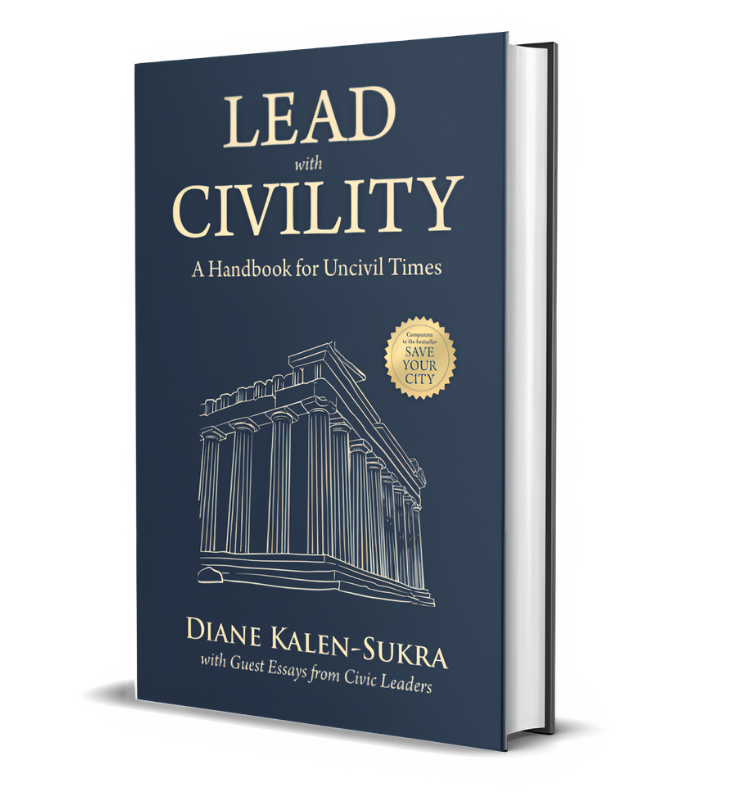
The front cover, harkening back to the classical age of Greek political philosophy as embodied and articulated by Plato and Aristotle, is a fit and fine icon of sorts, and the “Lead with Civility Creed” is worth meditating upon and internalising. The book is filled with thoughtful synthesis of both theory and practice, or in the classical sense, theoria and praxis.
The fact that Stoicism, as a type of public and political philosophy, is enjoying renewed interest—the Greek version more sophisticated and nuanced than the more applied Roman ethos—is worth noting. For Diane, it is the application of the essence of this classical ethos that can, if thoughtfully updated and applied, do much to restore the meaning of citizenship, civic virtues, and civility.
The obstinate fact that we live in a culture dominated by memoricide—a cultural amnesia that forgets the best of our civic inheritance—means many are ill-equipped to heed the centuries of political wisdom on civility in the public square and the cost of silencing dialogue across differences.
As Diane reminds us, this is not the first time a culture has lost its bearings. Seven centuries ago, Dante opened the Divine Comedy not with triumph but with disorientation, “midway in the journey of our life” in a dark wood. Leaders know the feeling: the path obscured, landmarks gone. Dante’s point is not despair but direction. There is a way through if we recover sight, courage, and companions for the road. May this book help you find all three.
I have taught political philosophy for more than thirty-five years and, within the centuries-long history of political thought and action, there are those who, like the perennial canaries in the mineshaft, warn one and all that toxins are infecting the souls, minds, and imaginations of many, and that corrections must be made to restore the body politic to the good, the true, the beautiful, and the just. Such is Diane’s vocation, and her published works and advocacy reflect such a unique calling.

The Greek tragedians tell us what happens when warnings go unheeded. Cassandra, the truth-teller no one believes, and Tiresias, the seer of unwelcome truths, still stand at the city gate.
The Canadian tradition is rich with such thinkers: Stephen Leacock, George Grant, Sheila Grant, and Judith Robinson, among other luminaries.
Diane has the deftness that comes from years in the fray, at the level of thought and action. She knows that frozen ideological postures, whether liberal–progressive or reactionary–conservative, are cul-de-sacs that undermine mature citizenship. Dante placed Satan at the lowest circle of the Inferno: ice-bound, wings flapping, going nowhere. It is an image of congealed thinking that she rightly opposes.
The phoenix does not rise on rhetoric. It rises on embers tended: memory restored, standards reset, trust rebuilt, truth told, compassion enacted, responsibility shared. That is the work before us. That is why this book matters.
Lead with Civility is a book to be studied, applied, and returned to often. Renewal is a craft, learned by doing again and again. Taken together with Save Your City, these works are a multi-coloured phoenix arising—a labour of beauty and necessity, truly a ten-bell book. May these pages be both mirror and map, revealing where we are and lighting the way for how, together, we may rise.
Dr. Ron Dart, Professor Emeritus
Department of Political Science/Religious Studies, University of the Fraser Valley
Professor of Classics, St. Stephen’s University


Comments